
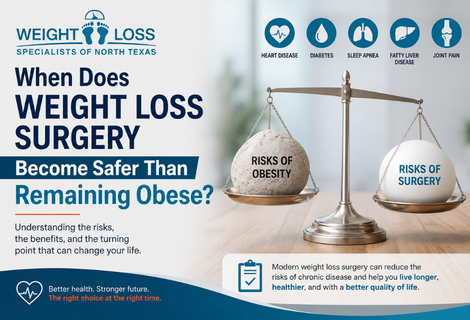
When Does Weight Loss Surgery Become Safer Than Remaining Obese?
Quick Answer
For many people with obesity, the long-term health risks of remaining obese far outweigh the risks associated with modern weight loss surgery. In fact, numerous studies have shown that bariatric surgery not only helps patients lose significant weight but also reduces the risk of diabetes, heart disease, stroke, certain cancers, and premature death.
While every patient should be evaluated individually, today’s minimally invasive and robotic bariatric procedures have become remarkably safe—often safer than many people realize.
Why Many People Overestimate the Risk of Surgery
When people hear the word “surgery,” they naturally think of risk.
What many don’t realize is that obesity itself is a progressive chronic disease that quietly increases the risk of:
- Heart attack
- Stroke
- Type 2 diabetes
- Sleep apnea
- Fatty liver disease
- Kidney disease
- High blood pressure
- Joint damage
- Certain cancers
- Early death
These risks don’t stay the same—they increase over time as obesity progresses.
The real question isn’t simply:
“Is surgery safe?”
It’s:
“Is continuing to live with obesity actually more dangerous?”
For many patients, the answer is yes.
How Safe Is Weight Loss Surgery Today?
Modern bariatric surgery has changed dramatically over the past two decades.
At Weight Loss Specialists of North Texas, most procedures are performed using minimally invasive robotic or laparoscopic techniques, resulting in:
- Smaller incisions
- Less pain
- Faster recovery
- Lower infection rates
- Shorter hospital stays
- Fewer complications than traditional open surgery
In experienced hands, bariatric surgery has a complication profile comparable to—or even lower than—many commonly performed operations such as gallbladder removal, hip replacement, and colon surgery.
The Risk of Doing Nothing
Many patients spend years trying diets, exercise programs, medications, and commercial weight-loss plans.
Unfortunately, obesity is not simply a matter of willpower.
It is a chronic metabolic disease that often becomes harder to treat over time.
Waiting another five or ten years can allow obesity-related conditions to worsen, including:
Diabetes
Long-standing diabetes becomes more difficult to reverse and increases the risk of blindness, kidney disease, nerve damage, and amputations.
Heart Disease
Excess weight places constant strain on the heart, increasing the risk of heart attack, heart failure, and stroke.
Sleep Apnea
Untreated sleep apnea significantly raises the risk of high blood pressure, abnormal heart rhythms, fatigue, and accidents.
Fatty Liver Disease
Non-alcoholic fatty liver disease (NAFLD) can progress to liver fibrosis, cirrhosis, and liver failure if left untreated.
Mobility Loss
Joint pain, arthritis, and reduced mobility often create a cycle where exercise becomes increasingly difficult, leading to additional weight gain.
When Does Surgery Become the Safer Option?
For many adults, surgery becomes an appropriate treatment option when they have:
- A BMI of 40 or greater
- A BMI of 35 or greater with obesity-related medical conditions such as:
- Type 2 diabetes
- High blood pressure
- Sleep apnea
- High cholesterol
- Fatty liver disease
The decision isn’t based on a single number alone.
Your bariatric surgeon also considers:
- Overall health
- Previous weight-loss attempts
- Medical history
- Current medications
- Lifestyle
- Personal goals
Every treatment plan should be individualized.
What About GLP-1 Medications?
GLP-1 medications such as Wegovy® and Zepbound® have helped many patients lose weight.
However, they aren’t the right solution for everyone.
Some patients:
- Stop responding to medication
- Regain weight after stopping treatment
- Experience intolerable side effects
- Need to remain on medication indefinitely to maintain results
For individuals with severe obesity or multiple obesity-related diseases, bariatric surgery often provides greater long-term weight loss and more durable improvement in chronic health conditions.
Rather than competing treatments, medications and surgery are best viewed as different tools that can be used individually or together based on a patient’s needs.
Benefits Beyond Weight Loss
Most patients think surgery is only about losing pounds.
In reality, many of the greatest benefits occur inside the body.
Patients often experience improvement or remission of:
- Type 2 diabetes
- High blood pressure
- Sleep apnea
- Acid reflux
- Joint pain
- Fatty liver disease
- Fertility issues related to obesity
- Mobility
- Energy levels
- Overall quality of life
Many patients also reduce or eliminate prescription medications.
Questions Patients Frequently Ask
Isn’t surgery dangerous?
Every operation carries some risk. However, modern bariatric surgery is considered one of the safest major abdominal operations when performed by experienced surgeons using minimally invasive techniques.
Am I “too old” for weight loss surgery?
Not necessarily.
Age alone rarely determines whether someone is a candidate. Overall health is often more important than chronological age.
Should I wait until my health gets worse?
Usually not.
Patients often achieve better outcomes when surgery is performed before obesity causes irreversible damage to the heart, kidneys, liver, or joints.
Is surgery considered a last resort?
Not anymore.
Current medical guidelines recognize bariatric surgery as one of the most effective treatments available for obesity and many obesity-related diseases—not simply a last option after years of unsuccessful dieting.
How do I know if I’m a candidate?
The best way is through a comprehensive evaluation with a bariatric surgeon who can review your medical history, current health conditions, previous weight-loss efforts, and long-term goals.
The Bottom Line
The conversation shouldn’t be “Is surgery risky?”
The better question is:
“What are the risks of continuing to live with untreated obesity?”
For many people, obesity poses a greater threat to long-term health than modern bariatric surgery.
If you’ve struggled with your weight for years, developed obesity-related medical conditions, or feel like you’ve tried everything without lasting success, it may be time to explore whether surgery is your safest path forward.
At Weight Loss Specialists of North Texas, we believe obesity deserves compassionate, evidence-based treatment—not judgment.
No Blame. No Shame. Just compassionate care that gets results.
Schedule a consultation to learn which treatment option is right for you.


